

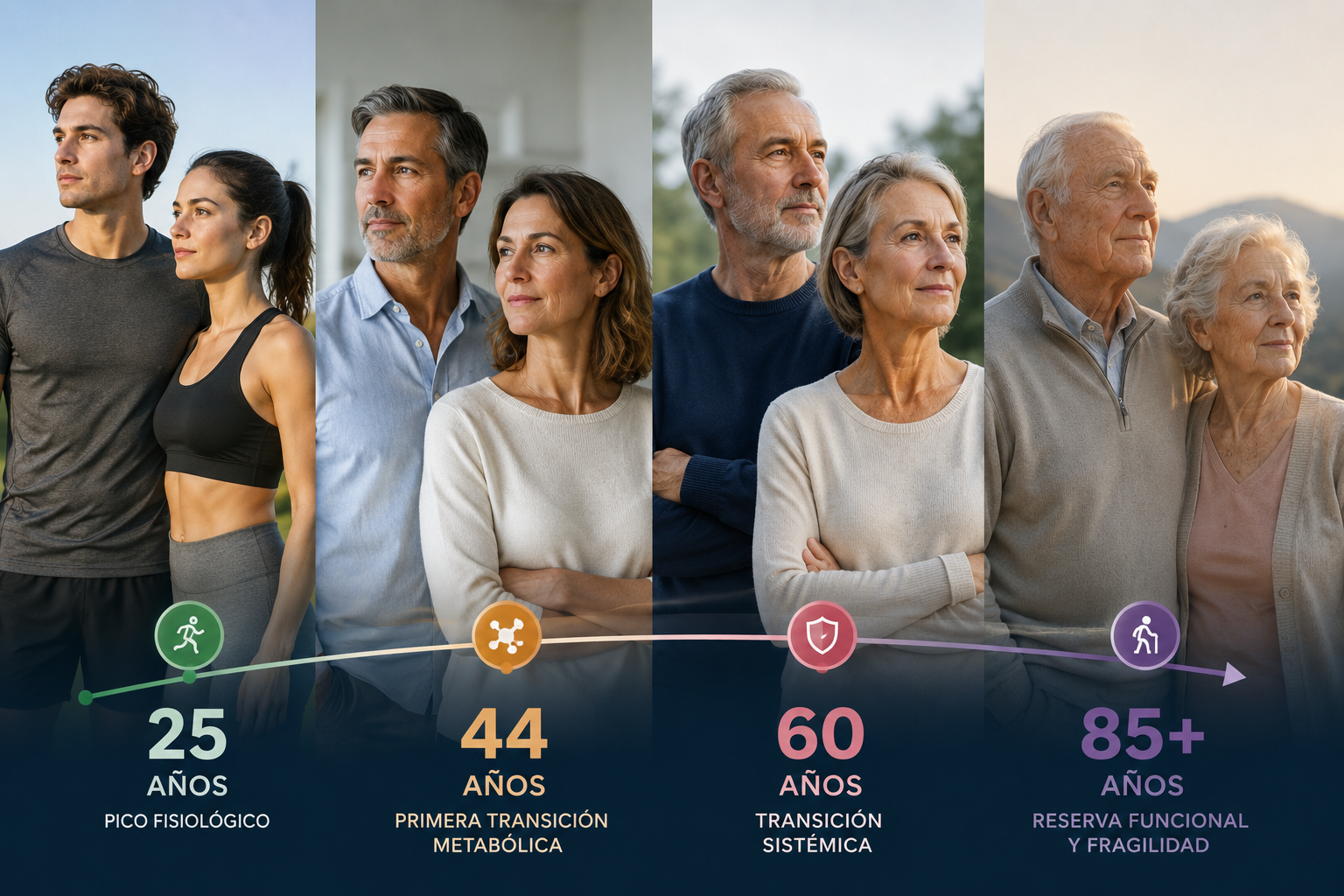
For a long time, it was assumed that ageing was a gradual, uniform and inevitable process: a slow succession of small physical and metabolic changes that accumulated over the years.
However, current biomedical research suggests a more complex reality. Ageing does not always progress in a linear fashion. There are stages of biological transition in which certain systems of the body undergo more intense changes, altering our metabolic, immune and functional capacity.
This does not mean that ageing occurs abruptly or in exactly the same way in everyone. Genetics, lifestyle, level of physical activity, diet, sleep and stress all play a decisive role. But it does seem clear that there are particularly significant moments in each individual’s biological trajectory.
The good news is that understanding these changes allows for earlier and more effective intervention.
Do we age gradually or in phases?
The classic model of ageing described a progressive and constant decline. However, recent research in molecular biology suggests that certain biological changes do not follow a straight line.
A longitudinal study conducted by researchers at Stanford analysed thousands of biomarkers — including proteins, metabolites, microbiota and other biological compounds — to observe how they evolved over time.
The findings suggest that a significant proportion of these markers exhibit non-linear changes, particularly around certain ages.
This does not imply that the body suddenly ‘breaks down’, but rather that some systems may undergo more pronounced periods of biological readjustment.
From a clinical perspective, this helps explain why many people report noticeable changes at specific stages of life, even whilst maintaining similar habits.
Key stages of biological ageing
Around 40–45 years of age: the first metabolic transition
At this stage, physiological changes usually begin that particularly affect metabolism.
Many people notice that:
• they gain weight more easily
• abdominal fat accumulates more quickly
• they tolerate alcohol less well
• they need more time to recover from exertion
• they sleep less well
• they experience more fatigue
From a biological perspective, changes may occur relating to:
• lipid metabolism
• insulin sensitivity
• body composition
• low-grade inflammation
• tissue repair
In women, this stage may also coincide with the menopausal transition, which adds significant hormonal changes. Progressive metabolic changes are also observed in men.
This period represents a critical opportunity for preventive action.
Around the age of 60: the systemic transition
The next stage usually involves a broader impact on various systems of the body.
Processes such as the following become more evident here:
• loss of muscle mass (sarcopenia)
• decreased aerobic capacity
• poorer glycaemic control
• decline in immune function
• increased vascular fragility
• progressive renal deterioration
It is common to observe:
• slower recovery from infections
• lower tolerance to intense exercise
• greater difficulty in maintaining strength and mobility
• higher incidence of hypertension
• sleep disturbances
At this stage, prevention is no longer just about avoiding future illness, but about preserving functional autonomy.
From 75–85 years: functional reserve and frailty
In old age, longevity is no longer the sole determining factor.
The question becomes:
How much functional capacity does one have upon reaching this stage?
Two people of the same chronological age may face radically different realities.
One may:
• walk independently
• maintain social activity
• retain muscle mass
• live independently
Another may experience:
• frailty
• frequent falls
• cognitive decline
• functional dependence
The difference is usually built up over decades.
Not everyone ages in the same way
One of the most interesting concepts in precision medicine applied to ageing is that there is no single universal pattern.
Some people develop metabolic changes earlier.
Others show earlier deterioration of the immune system, liver or kidney function.
This concept helps us understand why individuals of similar ages age so differently.
What might be your biological weak point?
This questionnaire has no diagnostic value, but it can help you identify areas that warrant clinical monitoring.
Metabolic profile
Do you recognise yourself in several of these situations?
• increasing difficulty in maintaining your weight
• drowsiness after meals high in carbohydrates
• persistent abdominal fat
• fluctuating energy levels throughout the day
• reduced tolerance to alcohol
This could suggest abnormalities in:
• insulin sensitivity
• energy metabolism
• glucose regulation
Immune profile
• more frequent infections
• slower recovery
• persistent fatigue
• slow healing
• increased sensitivities or inflammation
This could indicate immune vulnerability or low-grade chronic inflammation.
Liver profile
• frequent indigestion
• reduced alcohol tolerance
• feeling of bloating
• abnormal liver enzymes
• persistent fatigue after heavy meals
Liver health and lipid metabolism should be assessed.
Renal profile
• increased frequency of night-time urination
• fluid retention
• swelling in the ankles
• high blood pressure
• increased thirst
These symptoms warrant a medical check-up to rule out renal or cardiovascular disorders.
VO2 max: one of the best indicators of healthy ageing
If there is one functional marker that is particularly useful for estimating physiological capacity, it is VO2 max.
What is it?
VO2 max represents the maximum amount of oxygen the body can take in, transport and utilise during intense exercise.
It reflects the integrated efficiency of:
• heart
• lungs
• circulation
• muscles
• mitochondria
In simple terms: it is a measure of the body’s actual aerobic capacity.
Why is it so important?
A low VO2 max is associated with:
• higher cardiovascular mortality
• poorer metabolic health
• greater frailty
• reduced functional independence
• poorer exercise tolerance
• accelerated cognitive decline
Conversely, a good VO2 max acts as a protective physiological reserve.
It is not just about sporting performance.
It is about biological capacity.
Practical strategies for preserving functional capacity
Ages 20–30: building reserves
Objective: to maximise physiological capacity.
Priorities:
• strength training
• regular cardiovascular exercise
• avoiding smoking
• adequate sleep
• a high-quality diet
Everything built up here will have a cumulative impact.
Ages 30–40: consolidate
Objective: maintain muscle and metabolic efficiency.
Priorities:
• strength training 2–4 times a week
• sufficient protein
• stress management
• maintain healthy body composition
Ages 40–50: protect metabolism
Goal: to prevent accelerated decline.
Priorities:
• glucose control
• blood pressure control
• reduced alcohol intake
• quality sleep
• combined strength and cardio training
Ages 50–60: preserving function
Goal: to maintain independence.
Priorities:
• strength training
• balance exercises
• mobility
• cardiovascular health
• personalised clinical monitoring
Over 60: preserving independence
Objective: maintaining physical and cognitive function.
Priorities:
• daily physical activity
• sufficient protein
• mental stimulation
• active social life
• fall prevention
The real goal is not to live longer
Longevity, in itself, does not guarantee well-being.
The real objective is to preserve:
• mobility
• strength
• cognitive ability
• independence
• quality of life
Ageing is not just about adding years to life. It is about adding life to those years.
And many of the decisions that will determine how we reach old age are made long before the first symptoms appear.